Features · How you are related
How are we related?
Pick two people in your family tree and Shijro names the relationship, from maternal aunt to third cousin twice removed.
Try it free on Google PlayAndroid now, iPhone coming. Updated 24 October 2026.
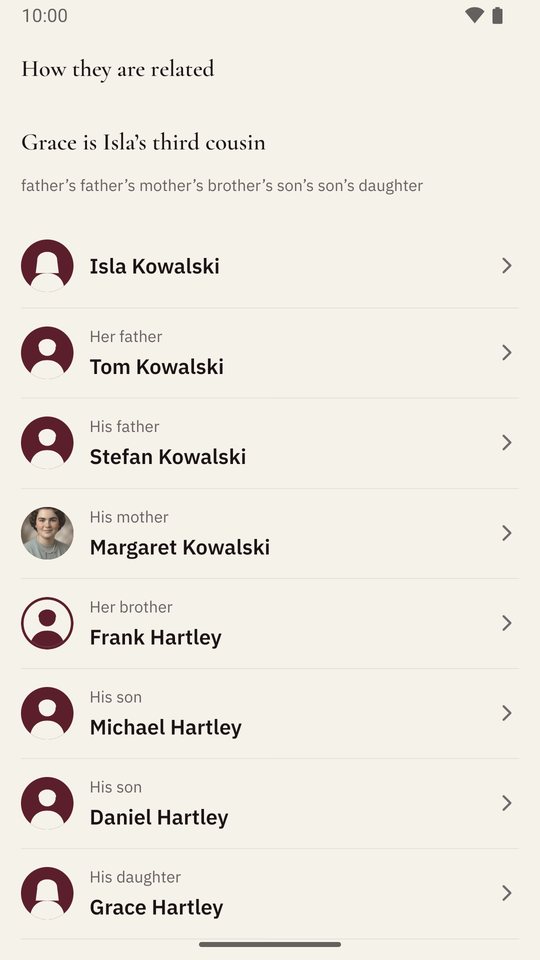
Choose any two people in your family tree and Shijro tells you what they are to each other, such as “Grace is Isla’s third cousin”. It also lists every person between them. It names relatives the way people say them out loud, including which side of the family they’re on, cousins removed, half and step relatives, and in-laws.
How to find out how two people are related
- Open the family tree in Shijro and tap one of the two people.
- Choose Relation to…, then pick the other person. They don’t need to be drawn on the screen, since you can choose anyone in the family.
- Shijro shows the name of the relationship and the path between them, one person per row. Tap any row to open that person’s page.
Once you’ve said which person in the family you are, you can skip all of that. Tapping anyone on the tree shows how they are related to you, and so does every relative’s page.
Why I show the whole path
My first version gave answers like “father’s father’s mother’s brother’s son’s son’s daughter”. That’s correct, but nobody talks like that. Now Shijro gives the name a person would actually use, “third cousin”, and lists the path underneath: Isla, her father Tom, his father Stefan, his mother Margaret, her brother Frank, his son Michael, his son Daniel, his daughter Grace.
The list works for any distance, needs no pinching or zooming, and a screen reader can read it aloud, which a drawn tree can’t do.
The names Shijro uses
- Your mother’s sister is your maternal aunt, and your father’s father is your paternal grandfather.
- Cousins of any distance, and how many generations apart they are: second cousin, first cousin once removed, third cousin twice removed.
- Further up and down the tree: great-grandmother, great-great-aunt, grandnephew.
- Half and step relatives: half-sister, stepbrother, stepmother.
- In-laws and their own families: son-in-law, grandmother-in-law, even your sister-in-law’s mother.
Cousins and “removed”, explained
First cousins share grandparents. Second cousins share great-grandparents, and third cousins share great-great-grandparents.
“Removed” means a difference in generations. Your parent’s first cousin is your first cousin once removed. That person’s child is in your generation, so they are your second cousin.
A great-aunt, also called a grand-aunt, is your grandparent’s sister. A grandnephew is your nephew’s or niece’s son.
Questions people ask
What is a second cousin?
Someone who shares a great-grandparent with you, in the same generation as you. First cousins share grandparents, second cousins share great-grandparents and third cousins share great-great-grandparents.
What does "once removed" mean?
It means one generation apart. Your first cousin's child is your first cousin once removed, and so is your parent's first cousin. Twice removed is two generations apart.
Does Shijro name in-laws and step relatives?
Yes: a brother-in-law, a stepmother, a half-sister, a grandson-in-law, and in-laws of in-laws like a sister-in-law's mother.
Does it know the difference between my mother's side and my father's?
Yes. An aunt on your mother's side is a maternal aunt and a grandfather on your father's side is a paternal grandfather.